.png)
For more than two decades, Patient Safety Awareness Week has been a moment for healthcare organizations to pause, reflect, and renew their commitment to safe, high‑quality care. But PSAW is far more than an annual observance. It is a strategic catalyst - an opportunity to reinforce safety as a shared cultural value across every point in the patient journey.
From EMS and hospitals to surgery centers, rural clinics, home health, and hospice, the Center for Patient Safety encourages all organizations to use PSAW as a platform to strengthen collaboration among the diverse providers who contribute to clinical excellence.
-1.png)
For more than 20 years, Patient Safety Awareness Week has served as an annual focal point for healthcare organizations to pause, evaluate, and re-energize their commitment to safe patient care. It isn’t just a commemorative event, however. It is a strategic tool used to hardwire safety into the culture of all those involved in the complex web of transitions that make up a patient’s journey. From EMS to hospitals and surgery centers, to rural health clinics, and home health and hospice, the Center for Patient Safety is encouraging all healthcare organizations to leverage PSAW to promote synergy between the diverse provider types that contribute to clinical excellence.
The importance of teamwork in healthcare delivery was highlighted in 1999 with the To Err is Human report. As a result of this groundbreaking report, leaders in healthcare research, like the Agency for Healthcare Research and Quality (AHRQ), developed strong methods to implement, improve and measure teamwork. Since then, teamwork has been recognized as one of the most foundational components to ensure high quality care and to mitigate preventable patient harm. It has grown to be an area highlighted by leading regulatory bodies as a requirement to become a highly reliable organization with long-term sustainability.
Teamwork encompasses several important concepts.
- Behaviors and attitudes reflect the reality of frontline providers: How willing are co-workers to pitch in and help one another; is there an awareness of other team members’ needs; is everyone respectful; does everyone recognize their role in the delivery of safe care?
- Processes and tools identify the organization’s provision of resources to support teamwork. This may include the implementation of a common method of communication (like SBAR), strong handoff procedures (like iPASS), and the availability of the right equipment.
- Leaders determine the priority of teamwork within the organization, creating a culture in which the components of teamwork are incentivized and celebrated. They remove barriers that create frustrations and can result in workarounds and, eventually, errors.
Much like a strong sports team, healthcare providers must be willing to work together, communicate clearly, and be guided by leaders with a clear vision.
The concept of teamwork and how communication, processes and leader support work together becomes much more convoluted as teams in healthcare must work with other teams. Flexibility becomes a requirement, debriefs are mandatory, and handoffs can mean the difference in the outcome of a patient.
The Center for Patient Safety encourages you to explore the different teams within your healthcare organization – and consider the teams that your teams work with to delivery patient care. Think about:
- Flexibility: Just as a player might cover for a teammate who is out of position, a nurse might assist a doctor with a procedure outside their usual work area. Consider ways for team members to anticipate need and understand different teams and different team roles. Please note, employees should be trained, competent, and confident in their ability to fill in for others.
- Debriefs: Pro athletes spend more time watching film than playing the game. High-performing healthcare organizations do the same through debriefs. Identifying the ‘touchdown’ moment where everything was perfect is just as important as analyzing a near miss or delayed handoff from EMS to the ED.
- Transitions: Many games are won or lost during transitions, like a pass that becomes an interception, or a dropped baton during a relay exchange. In healthcare, if the receiver doesn’t have a firm grip on the information, the patient ‘drops’, leading to readmissions or complications. Consider working with different healthcare teams (like EMS and a nursing home) to improve handoffs.
- Practice: Sports teams practice – a lot. Healthcare teams have opportunities to practice also. Consider simulation labs to build muscle memory so teams react instinctively.
If you’re looking for ways to understand the culture of your healthcare organization, the AHRQ Surveys on Patient Safety (SOPS®) allow any healthcare organization to identify and measure their own patient safety culture. The ability to measure staff perceptions of Teamwork, Handoffs and Transitions, and Leadership Support for Patient Safety enables an organization to identify its cultural strengths as well as areas of risk.
Organizations with survey results indicating strong Teamwork often have similar characteristics:
- Leaders round in areas regularly and follow-ups are monitored.
- Event collection (near misses, unsafe conditions, incidents) is encouraged and a system is in place to collect and evaluate events.
- Psychological safety promotes learning from events, celebrates near-misses, and includes proven methods to reduce provider burnout.
- Event learnings are shared with staff to educate, reinforce psychological safety, and create situational awareness.
- Event learnings are shared with governing bodies for them to understand risk and safety trends, review long-term viability, and hold the C-suite and management teams accountable.
In a five-year review of more than 67K safety culture survey responses received by the Center for Patient Safety, Leaders rated Teamwork more than 5% higher than other employee types (Nursing Staff, Other Clinical Staff, Support Staff). Notably, the Medical Staff, sometimes referred to as influential leadership, reports even greater perception of teamwork within their organization. These discrepancies suggest there is a disconnect between how those in leader roles perceive teamwork and how frontline staff actually perceive it to be.
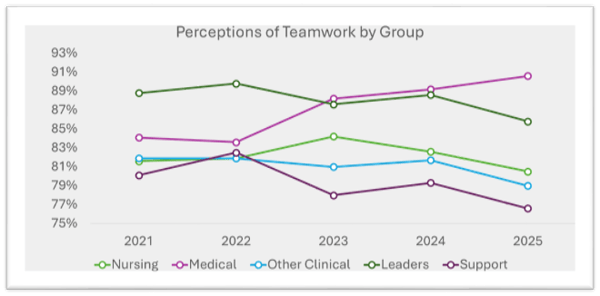
Solutions exist, such as rounding and in-depth, just-culture-based evaluations of safety challenges, but they require commitment at all levels to close the gap. We all win when teams work together, respectfully evaluate one another’s strengths and weaknesses, and find solutions together, and isn’t it up to all of us to protect the “goal” – the patient?
For PSAW 2026, the Center for Patient Safety encourages you to take action with your teams.
- For frontline team members: speak up. Your intuition is a clinical tool.
- For leadership team members: be approachable. If a team member comes to tell you about a near miss, shift your response from “Who made the mistake?”, to “How did the system fail you?”
- For patients and family team members: Be curious. If a medication looks different from the last time, or you think a step was skipped, ask why.
Patient safety improves when there is teamwork. If we keep the conversation going among all healthcare teams (EMS, home care, hospitals, clinics, surgery centers, pharmacies and more), we will reduce preventable harm.
Ask the Center for Patient Safety about diagnosing the strength of teamwork in your organization.