.png)
Next Week is Patient Safety Awareness Week. Here's Why Your EMS Agency Should Care.
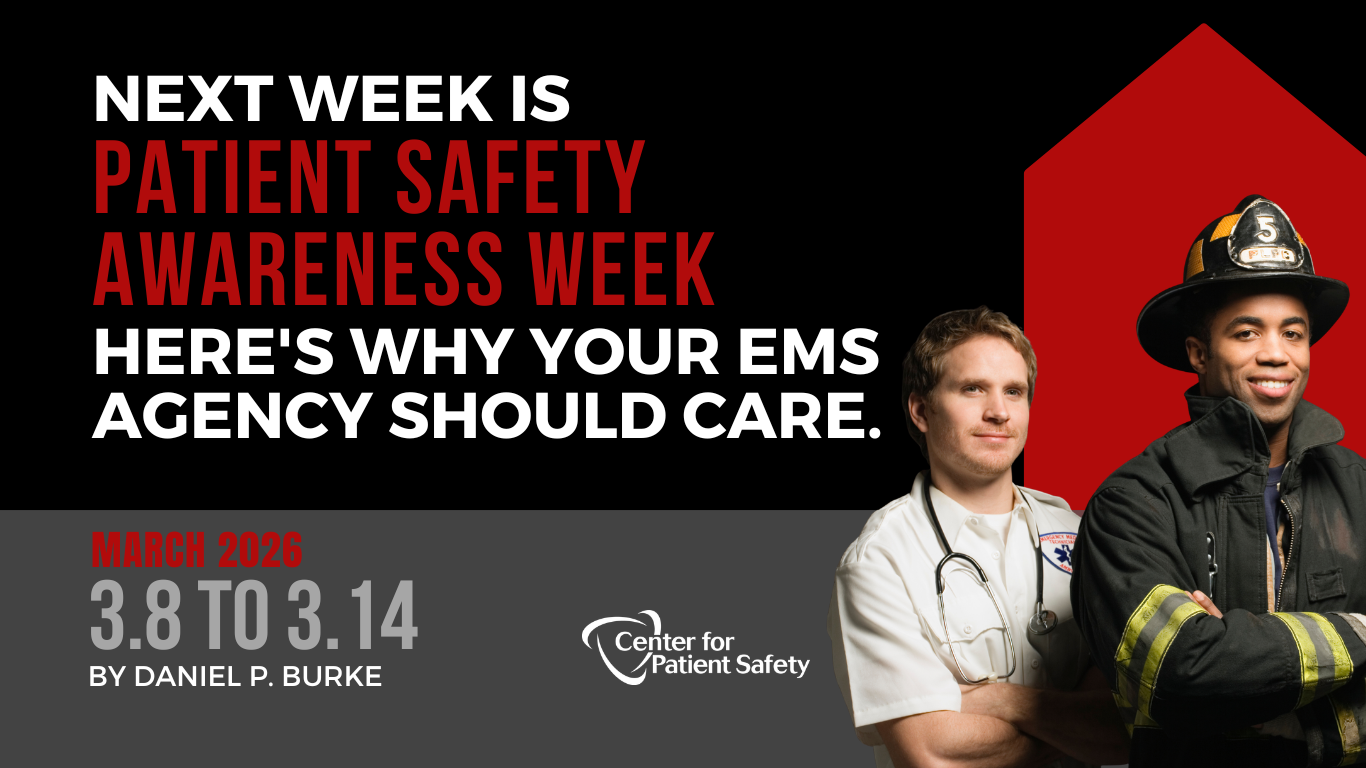
EMS Clinicians are the literal front line of healthcare safety. Even if the public sometimes views us as “first responders” rather than “clinicians,” the clinical decisions you make in a moving vehicle at 3:00 am are where safety matters most. Patient Safety Awareness Week is one of the clearest opportunities EMS has to close that gap, not just symbolically, but structurally.
The 2026 theme from the Center for Patient Safety is "Team Up for Patient Safety." The focus is on collaboration and communication between care teams, patients, and families. For EMS, that framing hits differently. EMS doesn't operate in a single facility with built-in escalation pathways and incident reporting infrastructure. EMS operates across thousands of calls, in uncontrolled environments, often without a direct feedback loop to review the outcomes that result from care delivered in the field.
Given these challenges, a week centered on safety becomes even more important in EMS.
Patient Safety Is Not a Hospital Problem
When most people hear "patient safety," they picture a hospital. Wrong medication, wrong patient, wrong procedure. When EMS Clinicians hear “patient safety,” they often hear “don’t drop the patient.” All of the deep-rooted research and support for patient safety, like the To Err Is Human report, AHRQ culture surveys, and Joint Commission standards, have been traditionally built for inpatient settings.
EMS has been largely absent from that conversation. Not because patient safety isn't a problem in EMS (it absolutely is), but because the systems, protections, and culture required to surface, report, and learn from safety events haven't been consistently built into the field.
EMS harm is underreported. Near misses disappear. Events that would trigger a root cause analysis in a hospital quietly resolve when the unit clears and goes back in service. The structural supports that make learning possible - reporting systems, just culture frameworks, protected event analysis, peer support - are still developing in EMS, and many agencies are still operating without them.
Patient Safety Awareness Week is a moment to tackle that head on.
What EMS Agencies Can Actually Do This Week
This isn't about hanging a poster in the day room. PSAW is a practical opportunity to do things that move the needle.
Launch a safety culture conversation. The Center for Patient Safety offers an EMS-specific safety culture survey. PSAW provides built-in momentum to drive participation and signals to your workforce that leadership is serious about hearing the truth, not just celebrating the wins.
Look at your near-miss reporting. If you're not capturing near misses and unsafe conditions, you're not learning. If reporting feels dangerous in your agency, that is a safety problem in itself. This week is a good time to assess that honestly.
Connect with your PSO. Federal Patient Safety Organization protections exist specifically to enable EMS agencies to report, analyze, and learn from events without legal exposure. If you're not yet participating in a PSO, Patient Safety Awareness Week is the right time to ask why not, and to find out how to get started.
Debrief something. Pick a call from the last month that didn't go perfectly. Don’t select a disaster. Instead, choose a call with a near miss, a communication breakdown, a delay, or an improvised workaround. Debrief it with your team using a systems lens - not to find who made a mistake - but to find what the system failed to provide.
Talk to your patients and families. Patients and families are active partners in safety. In EMS, that looks different than it does in a hospital, but it still applies. How do you communicate your plan of care on scene? How do you invite questions? These are patient safety questions.
The Toolkit Is Ready. It’s Yours to Use.
The Center for Patient Safety has built a free PSAW Toolkit specifically for EMS agencies, which includes banners, posters, social media assets, a sample staff email, and a press release template. It's designed to remove the friction so that participating doesn't require a large budget or a dedicated communications team.
Download the 2026 EMS PSAW Toolkit
The materials are available for public use without copyright restrictions. Use them. Customize them. Tag us on social media with #PSAW26 and @centerforpatientsafety and let the broader EMS and healthcare community see that your agency takes this seriously.
Why This Week Matters for EMS
Patient safety culture doesn't build itself. It doesn't get stronger because everyone is well-intentioned and works hard. It gets stronger when leadership creates structures that make safety visible, reporting safe, and learning systematic.
PSAW is one week. But what you do during this week speaks volumes: the conversations you start, the survey you launch, the debrief you actually hold. These signal to your workforce what the culture is allowed to be.
That's not a small thing.
Patient Safety Awareness Week: March 8–14, 2026. Team Up for Patient Safety.
Questions? Contact us at info@centerforpatientsafety.org.