.png)
In an ambulatory surgery center setting, a safety culture survey measures how your staff perceive communication, teamwork, staffing, and response to mistakes. By using a validated tool such as AHRQ Ambulatory Surgery Center Survey on Patient Safety® (ASC SOPS®), leaders gain a shared, data-driven view of risks and strengths across their organization.
Ambulatory surgery centers now perform about 60 percent of outpatient surgical cases, reflecting significant growth in both volume and complexity of care. At the same time, public reporting from groups such as CMS and Leapfrog is shining new light on how ASCs manage safety. A safety culture survey gives you a repeatable way to understand if your staff, processes, and culture can support safe, reliable care in this environment.
The ASC SOPS®, from the Agency for Healthcare Research and Quality (AHRQ) measures multiple dimensions that research has linked to outcomes: communication about patient information, communication openness, staffing and workload, teamwork, staff training, organizational learning, response to mistakes, and management support for safety. These concepts have been studied across hospitals, medical offices, EMS, and ASCs, creating a strong evidence base.
When ASCs use these surveys consistently, they can identify whether they are operating in a reactive, bureaucratic, or high-performing (generative) culture. For example, high teamwork scores often correlate with lower infection rates and fewer wrong-site surgeries. Conversely, low scores on non-punitive response to error may indicate that staff are hesitant to report near misses, which hides risk and can undermine performance on ASC Quality Reporting measures.
The importance of teamwork in healthcare delivery was highlighted in 1999 with the To Err is Human report. As a result of this groundbreaking report, leaders in healthcare research, like the Agency for Healthcare Research and Quality (AHRQ), developed strong methods to implement, improve and measure teamwork. Since then, teamwork has been recognized as one of the most foundational components to ensure high-quality care and to mitigate preventable patient harm. It has grown to be an area highlighted by leading regulatory bodies as a requirement to become a highly reliable organization with long-term sustainability.
Teamwork encompasses several important concepts.
- Behaviors and attitudes reflect the reality of frontline providers: How willing are co-workers to pitch in and help one another; is there an awareness of other team members’ needs; is everyone respectful; does everyone recognize their role in the delivery of safe care?
- Processes and tools identify the organization’s provision of resources to support teamwork. This may include the implementation of a common method of communication (like SBAR), strong handoff procedures (like iPASS), and the availability of the right equipment.
- Leaders determine the priority of teamwork within the organization, creating a culture in which the components of teamwork are incentivized and celebrated. They remove barriers that create frustrations and can result in workarounds and, eventually, errors.
Much like a strong sports team, healthcare providers must be willing to work together, communicate clearly, and be guided by leaders with a clear vision.
The concept of teamwork and how communication, processes and leader support work together becomes much more convoluted as teams in healthcare must work with other teams. Flexibility becomes a requirement, debriefs are mandatory, and handoffs can mean the difference in the outcome of a patient.
The Center for Patient Safety encourages you to explore the different teams within your healthcare organization – and consider the teams that your teams work with to delivery patient care. Think about:
- Flexibility: Just as a player might cover for a teammate who is out of position, a nurse might assist a doctor with a procedure outside their usual work area. Consider ways for team members to anticipate need and understand different teams and different team roles. Please note, employees should be trained, competent, and confident in their ability to fill in for others.
- Debriefs: Pro athletes spend more time watching film than playing the game. High-performing healthcare organizations do the same through debriefs. Identifying the ‘touchdown’ moment where everything was perfect is just as important as analyzing a near miss or delayed handoff from EMS to the ED.
- Transitions: Many games are won or lost during transitions, like a pass that becomes an interception, or a dropped baton during a relay exchange. In healthcare, if the receiver doesn’t have a firm grip on the information, the patient ‘drops’, leading to a return to surgery or complications. Consider working with different healthcare teams (like EMS and a nursing home) to improve handoffs.
- Practice: Sports teams practice – a lot. Healthcare teams have opportunities to practice also. Consider simulation labs to build muscle memory so teams react instinctively.
How to prepare your ASC team and leadership for a safety culture survey
A safety culture survey works best when your team understands why it matters and how the results will be used. Preparing leaders and frontline staff in advance helps increase participation, improve data quality, and build trust in the process and the findings.
Begin by clearly stating your goal: you are assessing culture to improve patient care, strengthen workforce well-being, and stay competitive in a changing market, not to single out individuals. Explain that surveys such as the ASC SOPS® are anonymous tools used across thousands of organizations and that results will be reviewed in aggregate, not by individual.
Next, align leadership. Ask each clinical, administrative, and quality leader to commit to three expectations: promote participation, protect confidentiality, and act on results. For example, a nurse manager can schedule protected time for staff to complete the survey, while the medical director can verbally reinforce that honest feedback will not lead to blame.
Set a practical communication plan. Use brief emails, huddle announcements, and posted reminders that answer three questions: what the survey is, how long it takes, and how results will be shared. Many ASCs find it helpful to use a simple phrase such as, “Your voice guides our safety priorities for the next 12 months”.
Survey delivery can be completed efficiently by harnessing technology. Send a survey link via email, post the link on a Company Intranet page, or post a QR code on flyers promoting the survey. Using a survey vendor may allow for additional options including direct-to-employee-email with follow-up reminders, text messages, or kiosk options.
Feel free to be creative to drive strong response rates. The Center for Patient Safety has been a survey vendor since 2010 has seen a variety of successful incentives. One organization conducted give-away drawings that included LEGO sets and gift cards. Another organization offered a yogurt buffet if their response rate goal was reached. A third center only offered the ability to contribute honestly, and they achieved a strong 85% response rate, suggesting even a free incentive can be enough to engage staff. There is no best practice to achieve a strong response rate at any organization; just be knowledgeable about what motivates your employees.
Finally, prepare for common concerns. Some staff worry that small teams make anonymity difficult. Address this up front by describing how responses will be grouped and reported so no individual is identifiable. When staff see that you have thought carefully about their psychological safety, they are more likely to respond candidly. Using a third-party survey vendor, like the Center for Patient Safety, offers an added layer of confidentiality.
Turning ASC safety culture survey results into improvement and regulatory readiness
Survey data only creates value when you translate it into specific, time-bound improvement actions. For ASCs facing new transparency from CMS and Leapfrog, linking survey findings to regulatory and accreditation priorities is especially important.
Start with a high-level view of your results. Which dimensions are strongest, and which fall below national benchmarks? For example, you may discover that “Communication About Patient Information” scores are high, but “Staffing, Work Pressure, and Pace” scores are well below the AHRQ ASC SOPS® database average. That pattern suggests your teams communicate well but are stretched thin, increasing the risk of errors during busy times.
Select two to three focus areas rather than trying to fix everything at once. If teamwork scores are low, you might implement structured pre-procedure briefings and debriefings in every operating room, using a standardized checklist aligned with goals from The Joint Commission on accurate patient identification and prevention of surgical mistakes. Track process measures (such as percentage of cases with documented briefings) alongside outcome data like near-miss reports.
Regulatory readiness should be woven into this work. For example, CMS’s Patient Safety Structural Measure for hospitals requires documented patient safety improvement strategies, and similar expectations may soon emerge for ASCs. Safety culture survey results can help demonstrate a systematic approach to identifying risk and prioritizing interventions if regulators or accrediting bodies ask how you evaluate safety.
When you integrate survey findings with other data sources (event reports, ASC Quality Reporting metrics, and Leapfrog Survey results), a story becomes visible about your organization’s commitment to learning and improvement.
Reducing administrative burden by partnering for ASC survey administration
Many ASC leaders support safety culture surveys in principle but feel overwhelmed by the work involved in doing them well. Designing the survey process, distributing it, ensuring confidentiality, and turning raw data into actionable reports can consume internal time and expertise.
Administering AHRQ’s ASC SOPS® on your own often requires creating digital survey collection forms, managing email lists, collecting responses, cleaning data, and building reports that leaders can understand. For a medium-sized center, this can easily add up to dozens of staff hours, especially if you are attempting to compare your results to national benchmarks manually.
Partnering with an experienced survey administrator can significantly reduce that burden. An arrangement with the Center for Patient Safety results in a qualified team of patient safety experts handling the logistics such as survey data capture, reminder schedules, secure data collection, and compliance with requirements for any state and national comparative database submissions. Your team receives ready-to-use reports with visual summaries that highlight priority areas and trends over time.
Equally important is expert interpretation. Patient safety specialists who understand ASC operations can help you understand why your response-to-mistakes scores may be lagging behind industry averages, or why teamwork ratings vary between procedure rooms.
By outsourcing administration and analysis, you protect staff time for what matters most: planning and implementing improvements based on the data.
Connecting safety culture, workforce well‑being, and patient outcomes in ASCs
Safety culture is not an abstract concept; it is closely connected to staff experience and patient outcomes. When culture is strong, ASCs are better positioned to attract and retain talent, maintain reliable processes, and manage rising case complexity.
Recent research has shown an inverse relationship between positive safety culture and staff intention to leave; and environments that support psychological safety and non-punitive responses to mistakes tend to see lower burnout and turnover.
On the patient side, better safety culture is associated with fewer infections, fewer medication errors, and fewer wrong-site surgeries. Dimensions such as teamwork and organizational learning are especially predictive. If team members feel comfortable speaking up about near misses, often their organizations are more likely to correct system flaws before they cause harm.
For ASCs, this connection has direct financial implications. Participation in programs such as the Medicare ASC Quality Reporting Program means that preventable events can affect both reimbursements and reputation. A center that uses culture survey findings to strengthen communication during handoffs between pre-op and post-anesthesia care, for example, may see fewer postoperative complications and better patient satisfaction scores.
By framing survey work as both a safety strategy and a workforce support strategy, leaders can show they value staff well-being as much as regulatory compliance.
Planning your next steps: A practical roadmap for ASC safety culture evaluation
Turning the idea of a culture survey into a concrete plan is often the hardest part. A clear, staged roadmap can help your center move from intention to action without overwhelming staff.
A simple four-phase approach works well for many ASCs:
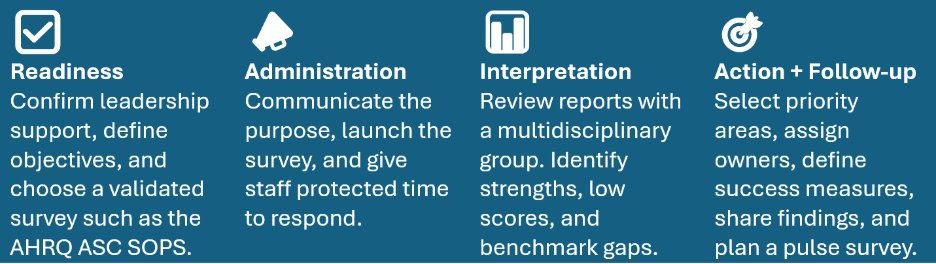
By approaching safety culture evaluation as a continuous, supportive process rather than a one-time requirement, ASCs can build a resilient foundation that supports safe care, a healthy workforce, and long-term competitiveness.
About the Center for Patient Safety
The Center for Patient Safety has been administering safety culture surveys using validated tools since 2010 throughout healthcare, including surveys designed specifically for ambulatory surgery centers, hospitals, medical offices, pharmacies, nursing homes, home-based care, and EMS (air and ground). Our approach combines efficient survey administration with expert interpretation, practical support, and options for deeper improvement consulting when organizations want to move beyond measurement into sustained culture change. Together, we are working toward our mission of reducing preventable harm.
Contact CPS to get started: Meet with a Survey Team Member or Request a Proposal
Learn more about the AHRQ ASC SOPS®